Is RetroBet Legal in Australia? Licence, ACMA and Player Risk
 Available in US
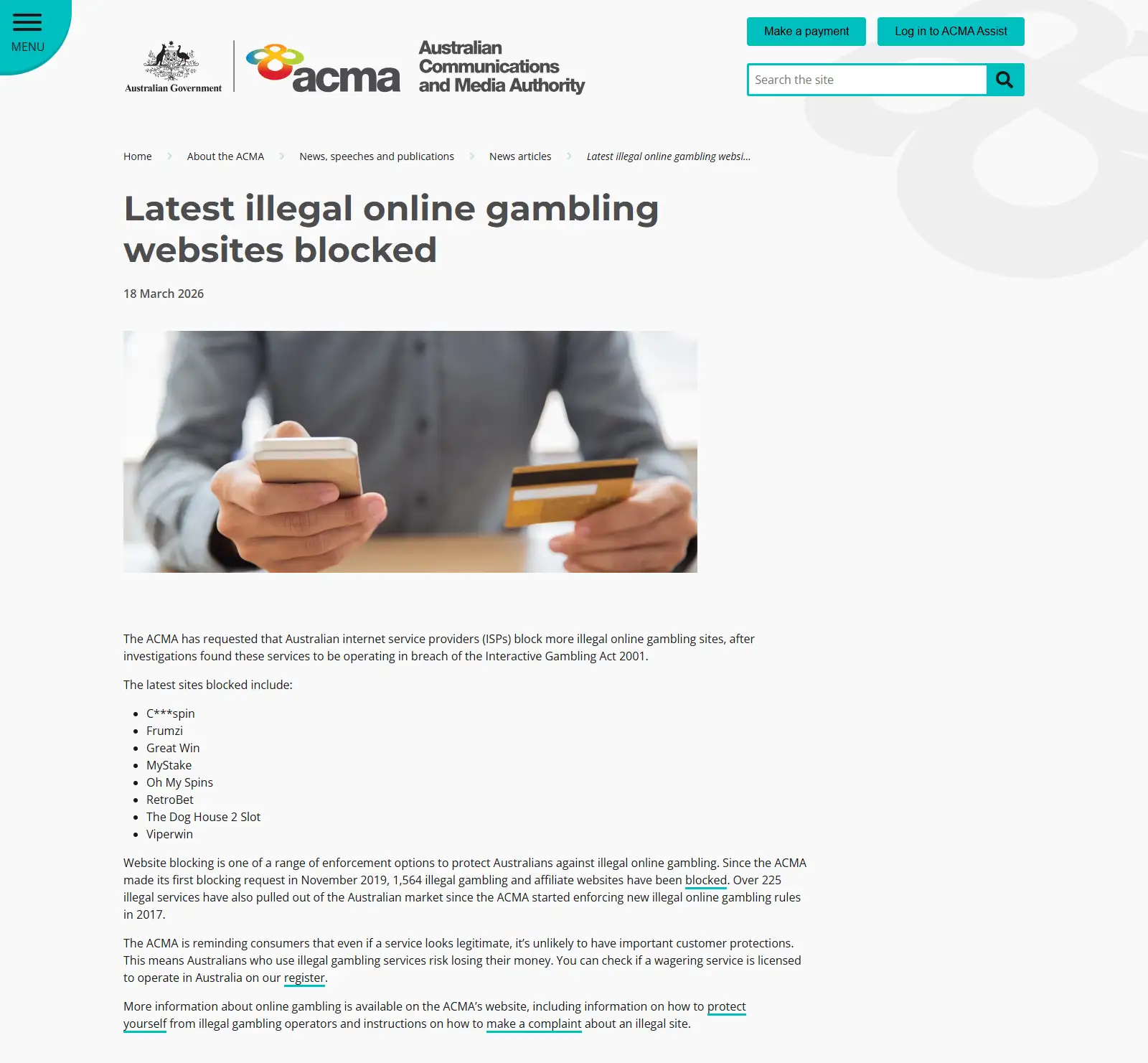
No Australian local licence was verified for RetroBet, and ACMA named RetroBet in an ISP-blocking action published on 18 March 2026 after investigations found the listed services operating in breach of the Interactive Gambling Act 2001. RetroBet’s operator, Stable Tech N.V., states that it operates under Curaçao Gaming Authority licence OGL/2024/161/0191.
Those facts should not be collapsed into a one-word slogan about whether an individual Australian player is “legal” or “illegal”. The strongest verified conclusion concerns supply and regulation: online casino-style services provided to customers in Australia fall within prohibited interactive gambling services under the federal framework, while licensed online wagering is a separate category. For an Australian reader, the practical issue is the weaker local regulatory protection and the real possibility of access disruption created by enforcement.
- The short answer: licence and ACMA status
- What ACMA did to RetroBet on 18 March 2026
- Australia versus Curaçao: two different licensing questions
- What the Interactive Gambling Act framework means here
- Why the Australian-facing site does not settle the legal question
- Games availability is not the same as regulatory permission
- Payments and withdrawals under a weaker local-protection position
- Advertising rules add another Australian compliance layer
- Timeline: March enforcement and August 2026 reform
- What about tax on player winnings?
- Practical risk implications for an Australian reader
- What this page does not conclude
- Bottom line: how to read RetroBet’s Australian status
The short answer: licence and ACMA status
| Question | Verified position |
|---|---|
| Australian local licence | No Australian local licence was verified for RetroBet. |
| Australian regulator action | ACMA listed RetroBet for ISP blocking on 18 March 2026. |
| Offshore operator | RetroBet is operated by Stable Tech N.V. |
| Offshore licence | RetroBet states Stable Tech N.V. operates under Curaçao Gaming Authority licence OGL/2024/161/0191. |
| Australian online casino framework | Online casino-style and online slot-machine services supplied to customers in Australia are prohibited interactive gambling services. |
| Licensed online wagering | Permitted online wagering is a separate category tied to licensed providers on the Australian register. |
The table explains why a Curaçao licence should not be described as an Australian licence. It is evidence that the operator identifies an offshore licensing jurisdiction, but it does not place RetroBet on Australia’s licensed interactive wagering register or give Australian users the same local-regulatory relationship they would have with an Australian-licensed wagering operator.
What ACMA did to RetroBet on 18 March 2026
ACMA published a notice on 18 March 2026 saying it had requested Australian internet service providers to block a new group of illegal online gambling sites after investigations found the services operating in breach of the Interactive Gambling Act 2001. RetroBet was explicitly named in that list. ACMA described website blocking as one of its enforcement options and reminded consumers that illegal gambling services may lack important customer protections.
This is direct regulator evidence, not an affiliate-site interpretation. It establishes that RetroBet was the subject of an Australian ISP-blocking request. It does not mean every Australian connection will show the same technical result at every moment, and it does not justify instructions for bypassing a block. Access can vary by ISP, domain and timing, but the enforcement action itself is a verified fact.
For a reader evaluating trust, this is more important than whether the site happens to load during one test. A successful page load is a technical observation; an ACMA blocking notice is a regulatory action. When the two appear to conflict, the regulator action should carry more weight in a risk assessment.
Australia versus Curaçao: two different licensing questions
RetroBet’s terms identify Stable Tech N.V. as the operator and cite Curaçao Gaming Authority licence OGL/2024/161/0191. That licence statement belongs to the operator’s offshore regulatory context. The Australian question is different: whether RetroBet holds the relevant Australian local authorisation or appears as an Australian licensed interactive wagering service.
| Layer | RetroBet position | What it means |
|---|---|---|
| Curaçao | Stable Tech N.V. is stated to operate under CGA licence OGL/2024/161/0191. | Offshore licensing information about the operator. |
| Australia | No local Australian licence was verified for RetroBet. | Do not claim Australian licensing, local compliance coverage or Australian dispute-scheme membership. |
| ACMA enforcement | ISP blocking requested in March 2026. | Direct evidence of Australian regulatory action against access to the service. |
A common mistake is to treat “licensed” as a complete answer without naming the jurisdiction. A licence can be real and still not be the licence required for the target market. This site therefore states the Curaçao jurisdiction directly and separately states that no Australian local licence was verified.
What the Interactive Gambling Act framework means here
Australia’s key federal online-gambling law is the Interactive Gambling Act 2001, enforced at the federal level by ACMA. Under the framework reflected in ACMA guidance, online casino-style services and online slot-machine services provided to customers in Australia are prohibited interactive gambling services. This is the category most relevant to RetroBet’s casino and pokies offering.
Online wagering is different. Australia allows certain interactive wagering services when they are appropriately licensed, and ACMA maintains a register that consumers can use to check licensed providers. The existence of that legal wagering category should not be used to imply that an offshore online casino becomes locally licensed merely because it also has sports betting or another wagering product.
This distinction is useful when reading broad marketing language such as “casino and sportsbook”. Each product has to be assessed against the applicable Australian framework. A site’s overall navigation cannot substitute for a regulator register entry or erase an ACMA enforcement notice.
Why the Australian-facing site does not settle the legal question
RetroBet currently has Australian-facing content, supports AUD and does not name Australia in its general restricted-country list. Those are operational facts about what the operator publishes and what its interface can present. They do not establish Australian regulatory approval.
The registration guide explains the same split at account level: an Australian country selection or AUD account option can show that a signup flow is technically available, while the regulator can still treat the underlying service as unlawful to supply. The two observations belong to different dimensions and should not be merged into “fully available” or “fully legal” shorthand.
For an Australian reader, the presence of localisation is therefore not a trust badge. It is useful for understanding currency, language and interface behaviour, but the ACMA notice remains the primary signal for regulatory risk.
Games availability is not the same as regulatory permission
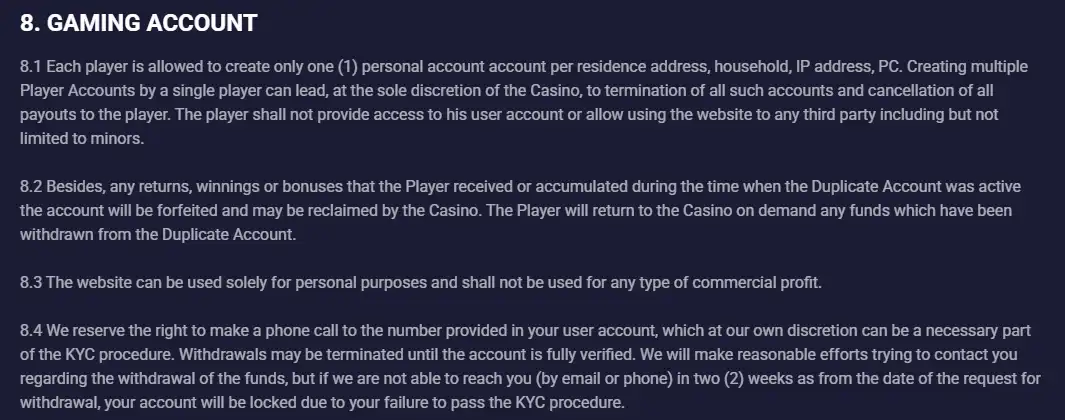
RetroBet’s current terms include Australia in restrictions for certain game providers, including NetEnt, Microgaming and Amatic. That helps explain why an Australian account may see a different catalogue from a user elsewhere. Provider restrictions, however, answer a product-availability question rather than a licensing question.
A game can be unavailable because of a provider’s distribution rules even where another part of a site remains accessible. Conversely, the fact that some games are visible does not prove the service is authorised under Australian law. The pokies and games page covers catalogue differences in detail, while this page keeps the focus on regulator status.
This separation prevents a misleading inference: “I can play a game, therefore the casino must be permitted.” Technical availability can persist until an ISP, provider or operator changes access. Regulatory permission requires a different evidentiary basis.
Payments and withdrawals under a weaker local-protection position
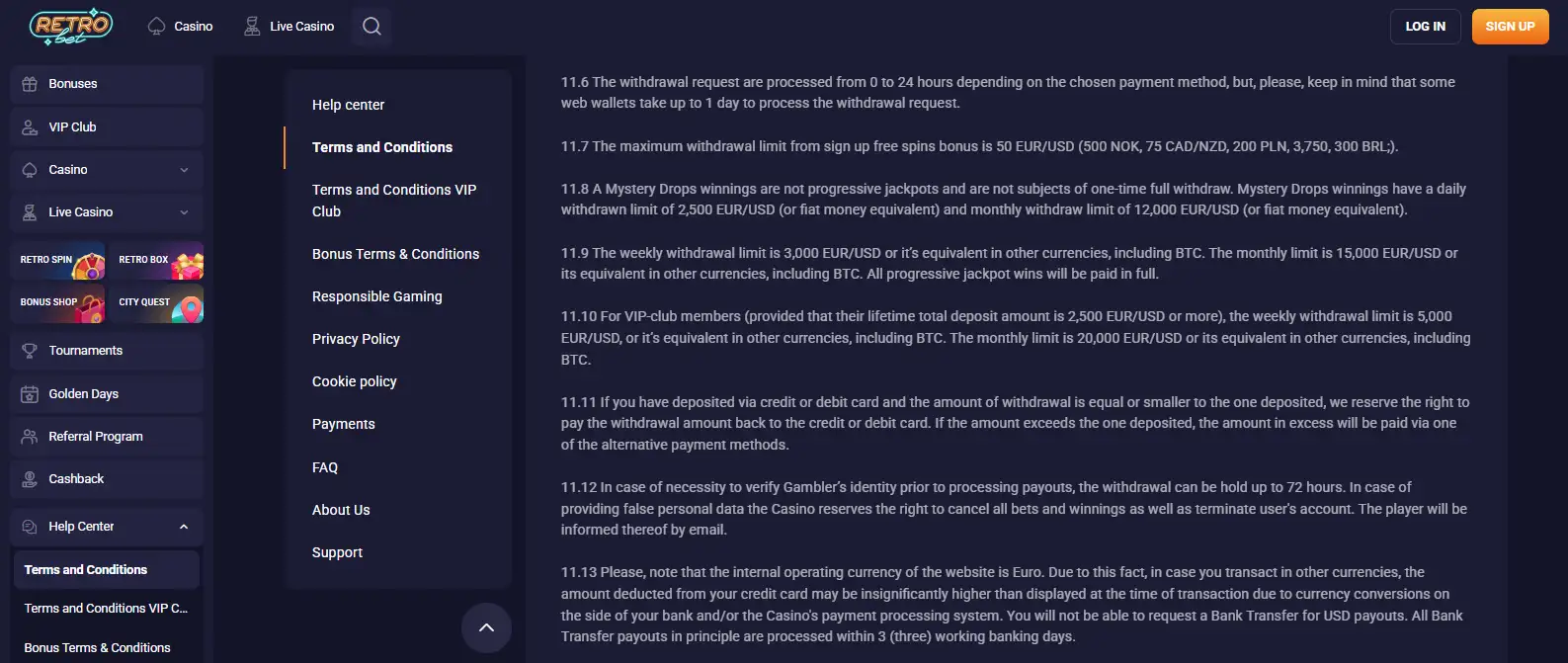
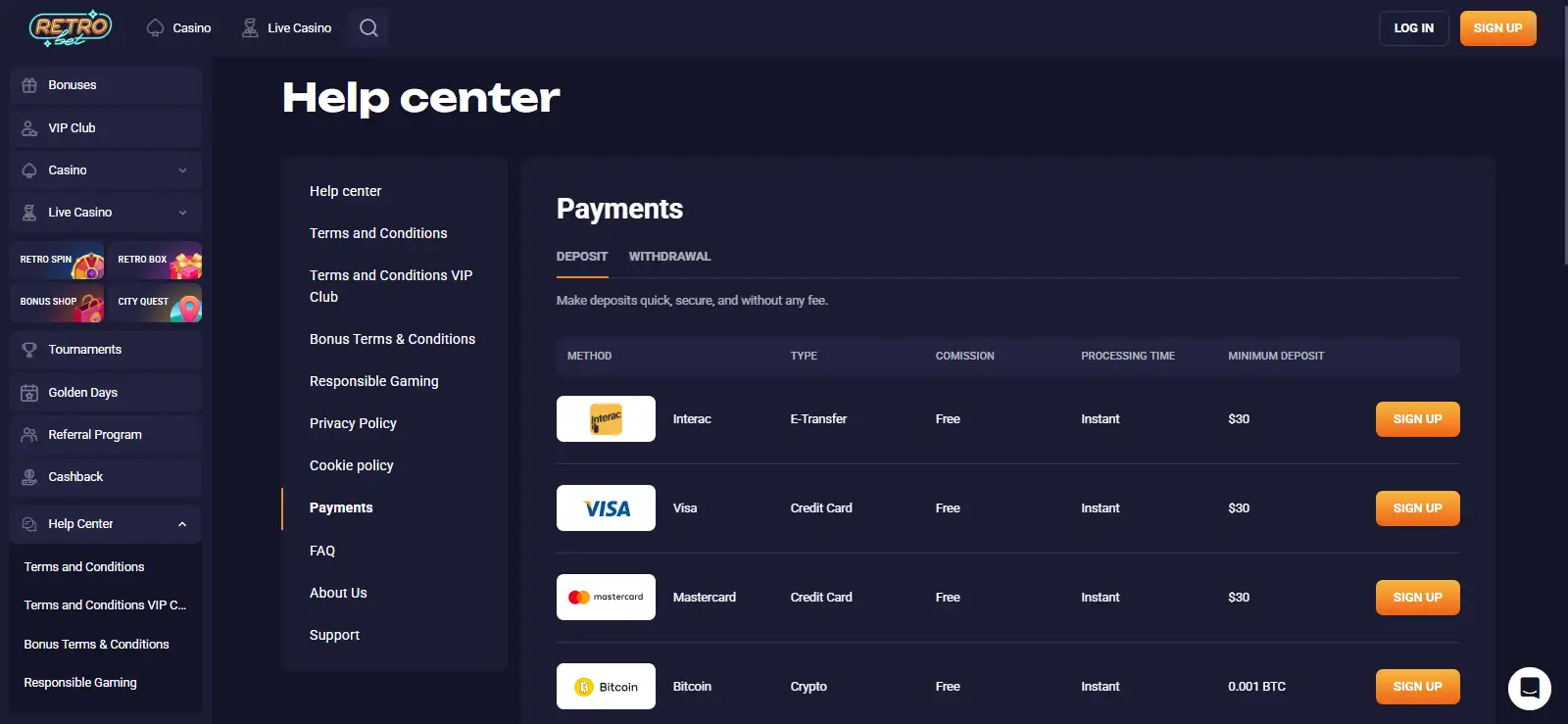
RetroBet publishes payment and withdrawal rules, and the payment methods guide covers the available operational evidence. Those rules can be relevant to a real account, but they do not create Australian consumer-protection coverage. No Australian local licence was verified, so this site does not claim that an Australian gambling regulator will handle a RetroBet account dispute as though it were a locally licensed service.
ACMA’s own blocking notices warn that consumers using illegal gambling services can face a risk of losing money and may not have important protections. For a player, this changes how apparently ordinary payment details should be weighed. A published processing time is useful, but recourse, continued site access and the ability to document a dispute also matter.
If money is already on an account, maintain independent records of deposits, withdrawals, account messages and transaction references. That is practical risk management, not an instruction to continue using the service.
Advertising rules add another Australian compliance layer
Australian rules also prohibit advertising prohibited interactive gambling services, including online casino-style services. This matters when evaluating how an offshore casino reaches Australian audiences. Promotional visibility does not establish permission to supply the underlying service, and an Australian-dollar offer is not evidence of a local licence.
For this site, that means bonus analysis remains factual and informational rather than being treated as proof of regulatory status. The bonus can exist as an operator-published offer while the Australian regulatory position remains adverse. Licensing, promotion eligibility and product availability are separate facts and should be verified separately.
Timeline: March enforcement and August 2026 reform
18 March 2026
ACMA published a blocking notice explicitly naming RetroBet among sites it asked Australian ISPs to block.
26 August 2026
The Interactive Gambling Amendment (Gambling Reform) Act 2026 received assent and is recorded on the Federal Register of Legislation.
1 January 2027
The enacted reform timetable records major substantive changes as scheduled to commence from this date.
The timing matters because the reform Act received assent on 26 August 2026, shortly before this page was prepared. Readers should distinguish law already in force from provisions scheduled to commence later. This page therefore treats the March 2026 RetroBet blocking action as an existing enforcement fact and the January 2027 changes as a forward-looking legislative milestone rather than pretending the future settings are already fully operative.
Regulatory pages have high freshness risk. If this article is republished later, the Federal Register and ACMA material should be checked again rather than assuming the August 2026 snapshot remains current.
What about tax on player winnings?
Australian tax treatment is another topic where simple casino boilerplate is unreliable. Australian Taxation Office guidance supports the general position that gambling winnings for an ordinary player are generally not assessable income, while different treatment can apply where gambling activity amounts to carrying on a business.
That is a general Australian tax point, not a statement that using RetroBet creates a special tax exemption. Personal circumstances can change the result, and tax status does not determine whether the operator is authorised to supply the gambling service. Because tax is a high-risk legal/financial detail, this page keeps the statement narrow and does not try to classify an individual reader.
Practical risk implications for an Australian reader
- Do not treat a Curaçao licence as an Australian licence. The jurisdiction matters.
- Do not treat a working signup page as proof of permission. ACMA has already taken blocking action against RetroBet.
- Expect access continuity to be uncertain. ISP blocking can affect whether the same domain remains reachable.
- Keep independent transaction records. Payment evidence matters more when local regulatory recourse is limited.
- Do not use provider availability as a legal test. Individual games can be restricted for separate commercial or geographic reasons.
- Recheck fresh regulatory sources. The legal framework is actively changing in 2026-2027.
These points are not a substitute for personal legal advice. They are a way to translate the verified regulator and licence evidence into a decision framework without claiming more than the sources support.
What this page does not conclude
This review does not say RetroBet holds an Australian licence, because no such licence was verified. It does not say Australian consumer-protection or dispute-resolution schemes apply to RetroBet. It does not provide instructions to circumvent ISP blocking. It also does not turn the existence of an offshore licence into a statement that the service is locally compliant.
Equally, it does not describe every operational feature as unverified merely because the local licence position is adverse. Bonuses, payments, games, currencies and registration fields are separate factual categories and are assessed on their own sources elsewhere on the site. The regulatory problem should be stated precisely rather than used as a reason to make unrelated product facts vague.
Bottom line: how to read RetroBet’s Australian status
The clearest current picture is a three-part one. RetroBet is operated by Stable Tech N.V. and identifies a Curaçao Gaming Authority licence. No Australian local licence was verified. Most importantly for Australian readers, ACMA explicitly named RetroBet in an ISP-blocking action on 18 March 2026 after finding the listed services operating in breach of the Interactive Gambling Act framework.
That combination creates a materially higher regulatory and access risk than a locally licensed Australian wagering service. If you are comparing RetroBet with other options, use Australian licensing status and regulator action as core decision criteria rather than relying on AUD support, localisation or the fact that a page happens to load.
For account-level issues, continue to the complaints and reputation page. For operational details separate from licensing, see the site’s pages on payments, registration and games.
For the broader context, return to the RetroBet Australia review.
Prepared by the Retrobet Casino editorial staff.